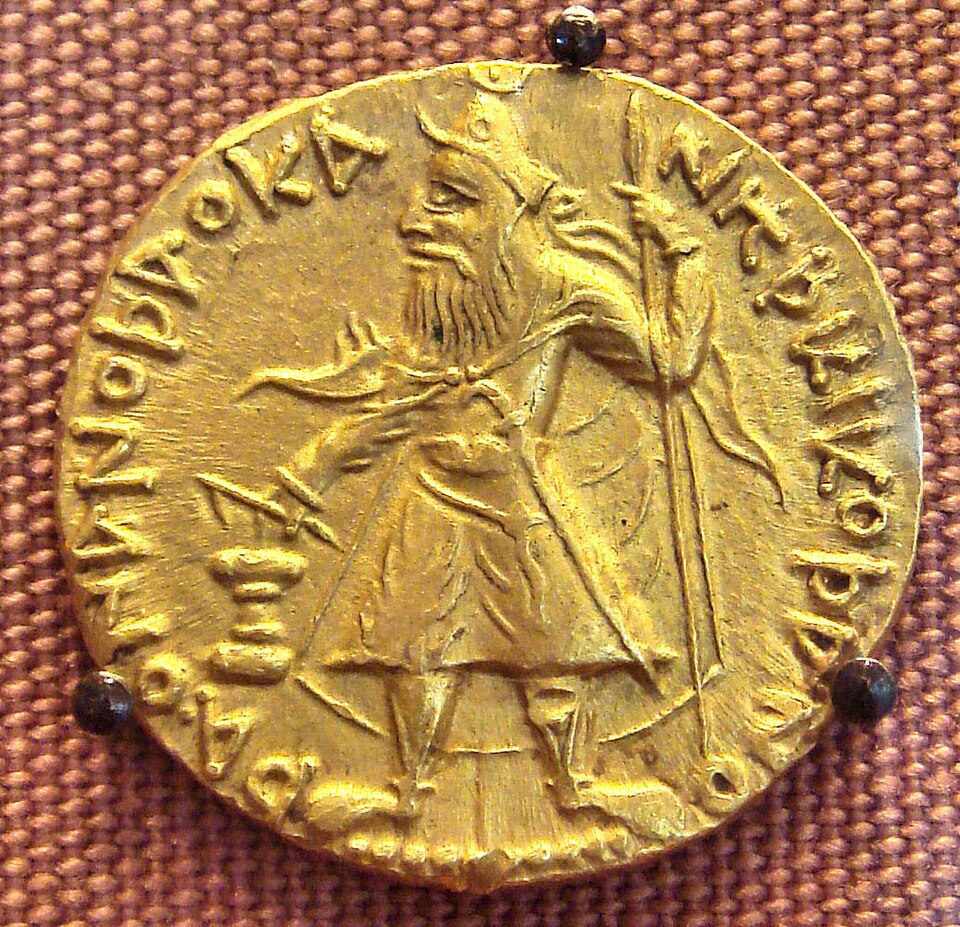
Kanishka was the greatest ruler of the Kushan empire, in the second century CE, whose lands stretched from Central Asia through Afghanistan and the Punjab to the Ganges. His winter capital was at Purushapura, now Peshawar.
He was a great patron of Buddhism. He built an enormous stupa at Peshawar, said by Chinese pilgrims to have been the tallest building in the world, and convened a Buddhist council in Kashmir. Under his rule Gandharan art flourished, with its Buddha images in a style mixing Greek and Indian forms.
His coins show him in Central Asian dress, with a long coat and boots, and carry Greek, Iranian, Indian and Buddhist gods. A headless statue of him from Mathura is one of the most famous portraits of ancient India. The era he founded, beginning in 127 CE, was used for centuries.
On the timeline
In the world's museums
2 objects Buddha type coin of Kanishka 127-150 CE first human depiction of BuddhaAshmolean Museum, Oxford · photo SpeakingArch (Wikimedia Commons) · CC BY-SA ↗
 Coin of Kanishka I, with Iranian solar deity Mithra (Miiro) on the reverseNational Museum, New Delhi · photo SpeakingArch (Wikimedia Commons) · CC BY-SA ↗