Language & scripts
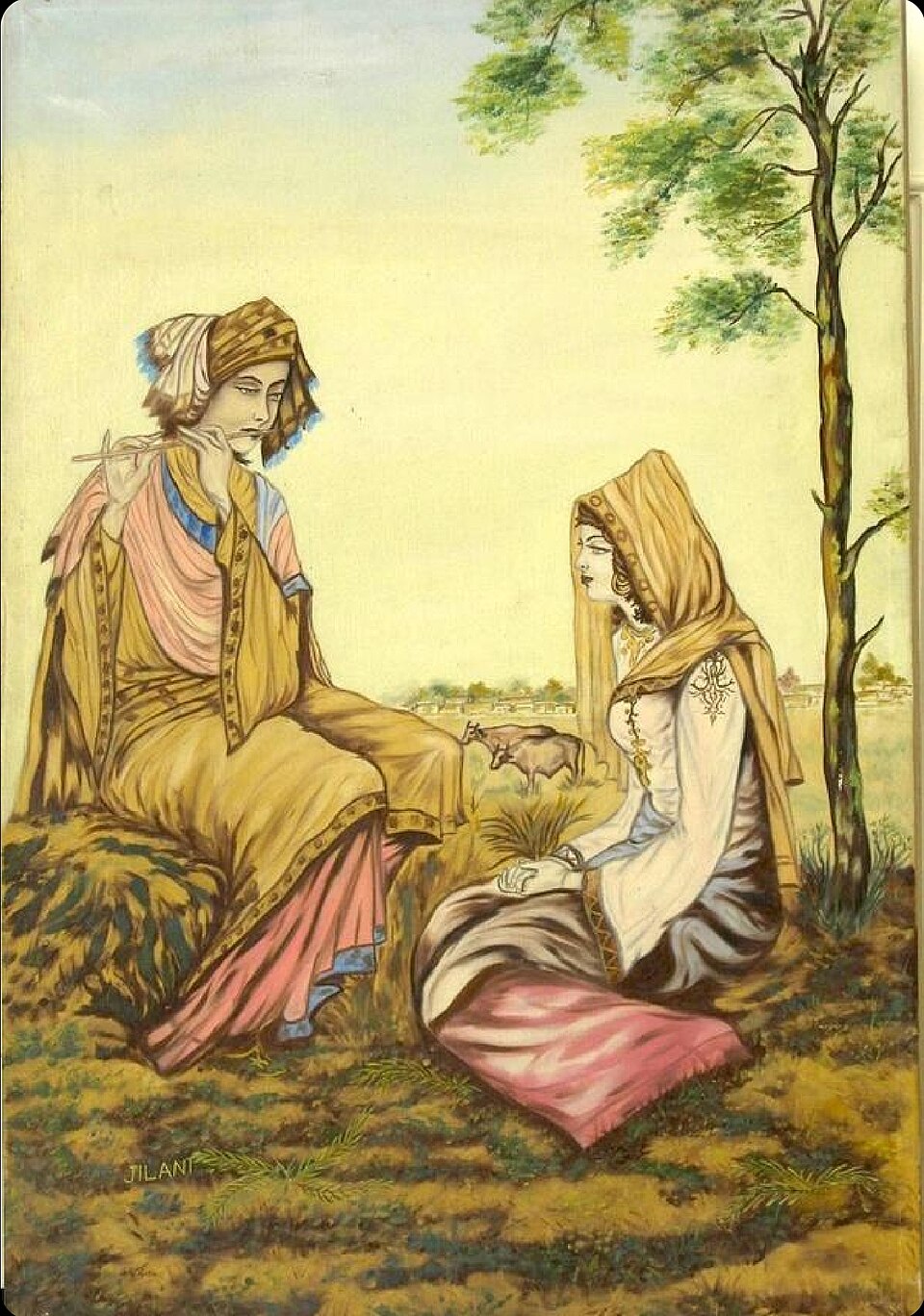
Punjabi is spoken by well over a hundred million people, more in Pakistan than in India, and written in two scripts: Gurmukhi in the east and Shahmukhi in the west. From Baba Farid's couplets to Waris Shah's Heer and the songs of today, it is the thread that ties the two Punjabs together.
Where the dialects are spoken
Areas are approximate; dialects shade into each other, and Saraiki, Hindko and Dogri are often counted as languages of their own.
One language, many voices
Punjabi grew from the spoken languages of the plains in the centuries after the Sultanate, and its first great poet was Baba Farid at Pakpattan in the thirteenth century. Its dialects run from the Majhi of Lahore and Amritsar, the basis of the standard language, through the Doabi and Malwai of the east to the Jhangochi of the bar, the Pothwari of the plateau, the Hindko of Peshawar and the Saraiki of Multan.
Speakers move across the dialects without thinking: the songs of Alam Lohar, the qisse of Waris Shah and the films of Lahore are understood from Peshawar to Delhi.
Dialect by dialect
Majhi, the Punjabi of Lahore and Amritsar, is the base of the standard language on both sides. Doabi is spoken between the Beas and the Sutlej, Malwai south of the Sutlej, and Puadhi around Ropar and Mohali. To the west, the dialects shade into what linguists call Lahnda: Jhangvi and Shahpuri in the bars, Dhani and Pothwari on the plateau, Hindko around Peshawar and Hazara, and Saraiki in the south-west around Multan and Bahawalpur, now often counted a language of its own.
A villager from Gurdaspur and one from Multan understand each other with a little effort; the songs, the proverbs and the qisse are shared by all.
One language or several?
The dialect chain, west to eastScroll sideways to see the whole figure →
The first scripts
The oldest writing of the Punjab after the undeciphered Indus script is Kharosthi, written right to left, brought by the Persian empire and used in Gandhara and Taxila from about the 4th century BCE: Ashoka's edicts at Shahbazgarhi and Mansehra are cut in it. Brahmi, written left to right, came from the east and is the ancestor of almost every script of India.
From Brahmi came Sharada, used in Kashmir and the hills, and from Sharada the Landa or 'tailless' scripts of the Punjab's traders and shopkeepers, and Takri in the hills. Gurmukhi, standardised by Guru Angad in the 16th century, grew from these, while Shahmukhi came with Persian and Arabic letters.
Where the scripts come from
A family treeSimplified: scripts borrowed from each other, and scholars differ on the details, such as how far Brahmi itself owes to Aramaic.
Gurmukhi
Gurmukhi, 'from the mouth of the Guru', was shaped in the sixteenth century, traditionally by Guru Angad, from the Landa and Sharada scripts used by traders and scribes in the Punjab. It became the script of the Sikh scripture, and since the Punjab Official Language Act of 1967 it has been the official script of Indian Punjab.
Gurmukhi is written left to right, with a line along the top like Devanagari, and its letters are recited in a fixed order beginning with ura, aira and iri.
The Gurmukhi alphabet
35 letters, with their Shahmukhi equivalentsAdded letters
Each card: the Gurmukhi letter, its name, its sound, and the nearest Shahmukhi letter. The 35 letters are learnt in these seven rows, the order of the alphabet; the first three carry vowels. Starred letters are written as aspirates but now spoken with a falling tone instead, which is what gives Punjabi its tones. Below: dotted letters added later for Persian and Arabic sounds, which Shahmukhi has letters for. A dash means there is no single matching letter.
Shahmukhi
Shahmukhi, 'from the mouth of the king', is the Perso-Arabic script as adapted for Punjabi, written right to left in the flowing Nastaliq style. It has been used for Punjabi poetry for centuries, by the Sufis and the qissa poets, and is the script of Punjabi in Pakistan.
In Pakistan Urdu and English are the official languages of the Punjab; Punjabi, though the mother tongue of most of the province, has little place in schools, and campaigners have long asked for it to be taught.
Language and politics
Language became a line of division in the twentieth century. In the censuses of 1951 and 1961, during the campaign for a Punjabi-speaking state, many Punjabi Hindus in East Punjab gave Hindi as their mother tongue, and the state was divided along language lines in 1966. In Pakistan the Saraiki movement argues that Saraiki is a language of its own and asks for a province of the south-west.
Despite all of it, the Punjabi of a Lahore film song and of a Ludhiana wedding is the same language.
Sources: G. A. Grierson, Linguistic Survey of India, vol. 8–9 (1916–19); Christopher Shackle, writings on Punjabi and Saraiki; Census of India 1951 and 1961; Wikipedia.